
Water Surges Into Navajo Reservoir
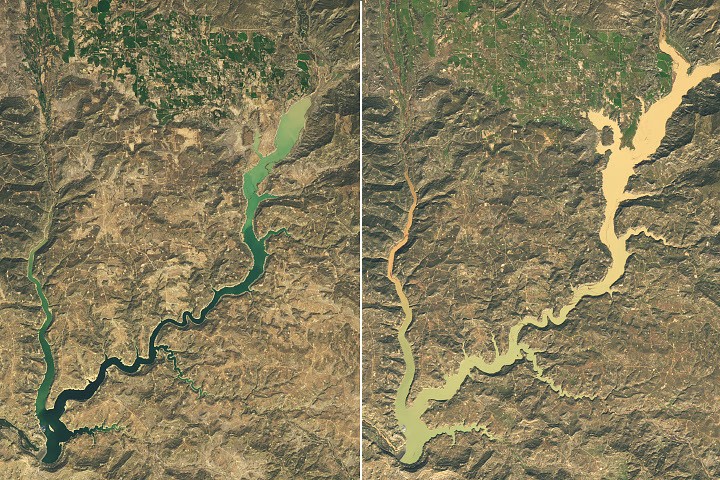
Image of the Day for November 11, 2026
Rounds of heavy rain in the U.S. Southwest flooded rivers and rapidly raised New Mexico’s second-largest reservoir.
Nov 11, 2026
View more Images of the Day:
Back-to-back extreme rain events inundated the Four Corners region of the U.S. Southwest in late October and early November 2026. The storms alleviated short-term drought conditions in the Southwest but caused river levels to spike to record or near-record levels in places, triggering damaging floods.
One effect of the heavy rains detected by satellites was the rapid rise of water levels in Navajo Reservoir. The change is visible in the images above, acquired on September 20 (left) and November 7 (right) with the OLI (Operational Land Imager) on Landsat 9. In that time, the lake in northern New Mexico and southern Colorado rose by nearly 60 feet (18 meters), according to data from the U.S. Army Corps of Engineers. (Note that the Bureau of Reclamation decreased releases from Navajo Dam on September 16 and 17.)
On November 7, the reservoir stood at its highest level since August 2019 and at 108 percent of the average capacity for that date. That contrasts with September 20, when it held just 60 percent of its average capacity. Due to snow drought across the West in winter 2025-26, the lake saw relatively little growth in the spring, when snowmelt often raises water levels.
The San Juan, Piedra, and other rivers swelled with runoff amid the wet weather. Pagosa Springs, Colorado, a town along the San Juan River about 40 miles (64 kilometers) northeast of the lake, was especially hard-hit by flooding. In the first round of rain, 5.05 inches (12.8 centimeters) fell in the town, and on October 23 the river reached major flood stage. After more rain, the river spiked again on November 1, this time nearly to the record level set in 1911 during a devastating flood. Officials issued evacuation orders, and responders rescued dozens of people, according to news reports, while water inundated streets and damaged property.
Heavy rain and flooding have been widespread across southwest Colorado, southeast Utah, northern Arizona, and northwest New Mexico in recent weeks. From early September through early November, precipitation totals were 2 to 4 times the average throughout the Four Corners region—an area beset by long-term drought that was exacerbated by snow drought and high temperatures in 2026.
Though the downpours posed hazards to communities along many rivers, they did provide drought relief throughout the region. Weekly U.S. Drought Monitor maps, derived from a suite of satellite data products and ground-based observations, have indicated improvements to drought conditions due to the fall storms. The group’s November 3 summary noted that “short-term drought has ended for the Southwest and Great Basin,” although long-term drought persists in places.
Wet weather in the Southwest is often associated with El Niño events, when the segment of the jet stream flowing eastward near the equatorial Pacific tends to strengthen. Experts noted that the low-pressure system delivering the heavy rainfall in autumn 2026 was at a low latitude for the time of year and drew energy from unusually high ocean temperatures. El Niño patterns—like the one currently underway—can increase the likelihood of moisture-laden storms being steered across the Southwest interior.
NASA Earth Observatory images by Michala Garrison, using Landsat data from the U.S. Geological Survey. Story by Lindsey Doermann.
Downloads
September 20, 2026
November 7, 2026
- AP News (2026, November 3) Rain clears but flood risk remains high after destructive storms swamp normally arid US Southwest. Accessed November 10, 2026.
- Center for Western Weather and Water Extremes (2026, October 28) CW3E Event Summary: 21-23 October 2026. Accessed November 10, 2026.
- The Gazette (2026, October 24) Pagosa Springs experiencing once-a-century flooding. Accessed November 10, 2026.
- NOAA National Water Prediction Service (2026) River Gauge Observations & Forecasts. Accessed November 10, 2026.
- U.S. Army Corps of Engineers (2026) Navajo Reservoir. Accessed November 10, 2026.
- U.S. Drought Monitor (2026, November 5) West. Accessed November 10, 2026.
- Weather West (2026, October 30) As unusual low-latitude storm approaches SoCal and threatens serious Four Corners flood risk once again, record-warm and record-high ocean conditions persist along CA coast amid still-strengthening El Niño. Accessed November 10, 2026.
You may also be interested in:
Stay up-to-date with the latest content from NASA as we explore the universe and discover more about our home planet.
Keep Exploring
Discover More from NASA Earth Science
Comments 0
Leave a Reply
Your email address will not be published. Required fields are marked *
Science
Explore All

Whats New
View All
‘Ramayana’ Journey Across Asia Anchors Discovery Docuseries Marking Shashi Tharoor’s TV Hosting Debut (EXCLUSIVE)

Saudi-led coalition intercepts Houthi missiles targeting Riyadh and south

Hearst Canvas Launches Frontier Collective Brand as U.K. Arm Builds Digital-Native Content Slate for YouTube

‘The Altruists’ Review: Netflix FTX Series Fails to Get a Handle on Crypto Scammer Sam Bankman-Fried

Trump's massive DC triumphal arch project dealt another blow by federal judge

Why is Pete Hegseth strengthening US military ties with Venezuela?

Gaza Syndrome: Why Israeli soldiers’ trauma erases Palestinian victims

'You will regret it': Angry resident confronts Democratic mayor during chaotic council meeting

Charting the world’s biggest IPOs as Anthropic overtakes SpaceX
