
Under the Microscope: NASA-Made Material for Moon Manufacturing
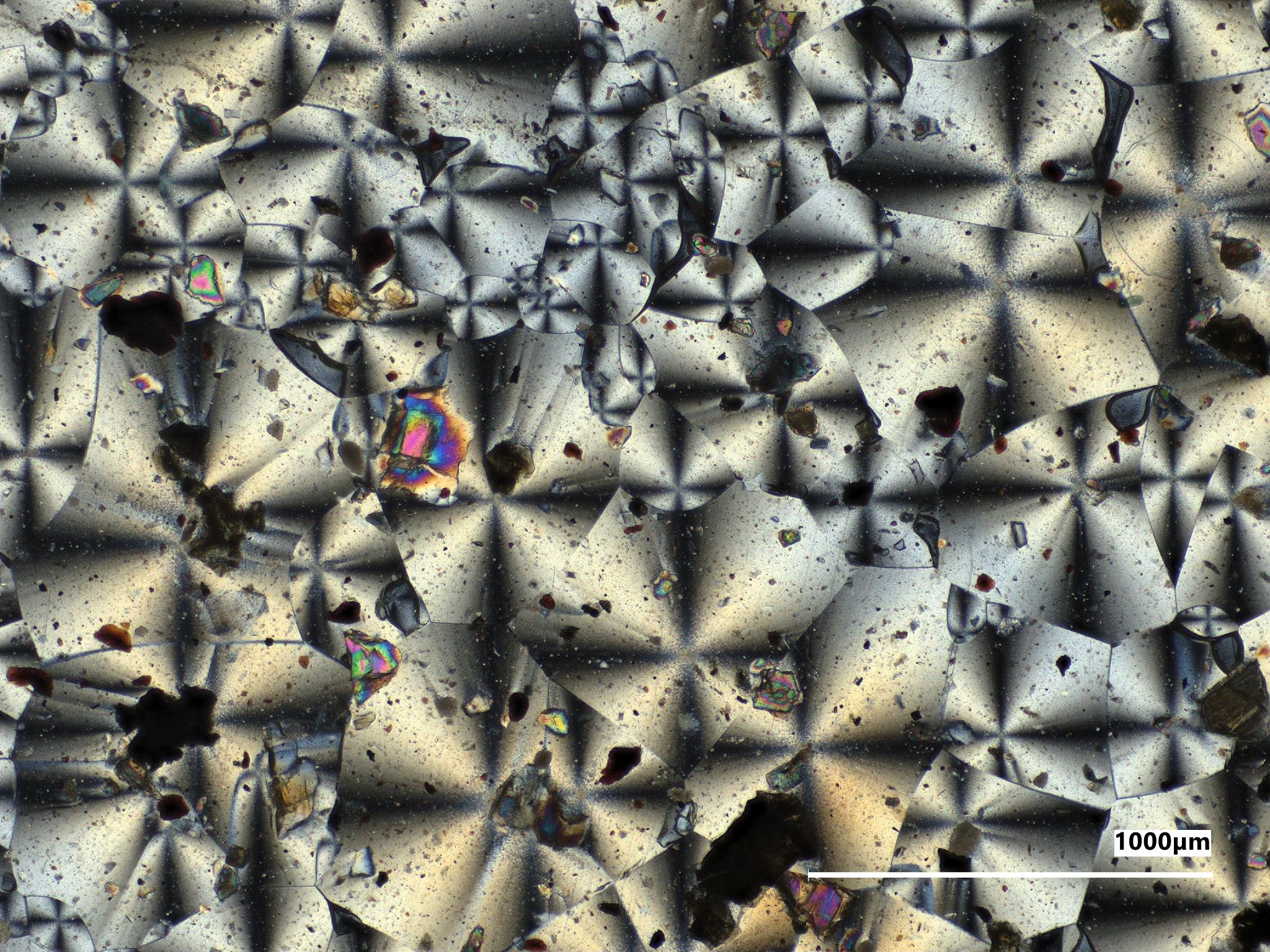
Photos taken using a microscope reveal the colorful, kaleidoscope-like crystal structure of a new NASA-made material that could be used for manufacturing during future space missions. Developed at NASA’s Glenn Research Center in Cleveland, the material could be created directly on the Moon or Mars, allowing NASA to pack fewer supplies — saving weight and reducing launch costs.
To make the material, research chemical engineer Allison Christy and her team of summer interns at NASA Glenn — Tyler Klinchuch, Ethan Bilodeau, and Emma Levenson — mixed a special plastic with simulated Moon and Mars dust. This plastic is biodegradable and could be produced by bacteria fed with crew waste or carbon dioxide.
“The plastic literally grows within the bacteria’s little bodies,” Christy said. “It’s really cool.”
The team found that incorporating simulated lunar and Martian dust particles into this plastic made it stronger and easier to process. Adding different types and amounts of dust allowed them to adjust the material’s properties. The gray image shows sample material manufactured using mock Moon dust, while the reddish image shows material made with mock Mars dust.
The material could be used to manufacture equipment used inside future Moon or Mars habitats, like structural brackets, wrenches, or chairs. By potentially enabling on‑demand, fully recyclable fabrication with lunar surface material, this could help advance NASA’s objective of a permanent Moon Base by reducing resupply needs and empowering crews to build and repair essential equipment on-site.
“You can’t just bring everything with you to the Moon or Mars,” Christy said. “If something breaks, you have to find a way to fix it with what you have. This is a very versatile material, which is a huge benefit.”
Going forward, the team hopes to analyze whether this material could also be used outside in the harsh environments of the lunar or Martian surfaces.
The material is now undergoing testing in Glenn’s Lunar Environment Structural Test Rig to see how it holds up in extreme temperatures. Several samples are also slated to launch aboard the upcoming Materials International Space Station Experiment 23 (MISSE-23) mission and will be exposed to intense conditions outside the station.
This research is funded through NASA Glenn’s 2026 Center Innovation Fund, which is managed by the agency’s Research and Technology Mission Directorate.
Learn more about the program:
Comments 0
Leave a Reply
Your email address will not be published. Required fields are marked *
Science
Explore All
NSTGRO 2026
NSTGRO Homepage Omar AlyousefUniversity Of MemphisPolycatenated Architected Materials (PAM) for Origami-Inspired Space Docking Ports Cade ArmstrongUni...
Under the Microscope: NASA-Made Material for Moon Manufacturing
2 hours ago
The ice blasting from Saturn's moon Enceladus is stranger than scientists realized
6 hours ago
Earth’s day isn’t exactly 24 hours. The reason may lie deep inside the planet
10 hours agoNASA’s Crew-13 could go from Florida to the ISS in under 9 hours
11 hours agoWhats New
View All
After losing his voice to cancer, this founder is building “glasses for voice”

Here’s Where to Watch MLB Playoffs 2026 Live Online for Free

How Britney Spears and the ‘Cannibal Cop’ Left Erin Lee Carr Forever Changed

Oura shelves its $2.2B IPO citing ‘uncertainty’ in the market

‘Sin Filtro’ Producer JK Media Producing First Original Microdramas Shot in the U.S. for TelevisaUnivision’s ViXMicrO (EXCLUSIVE)

Republicans fear they ‘haven’t done a damn thing’ to lower prices ahead of midterm reckoning

Tom Hollander Joins Season 2 Cast of AMC’s ‘The Audacity’

Jia Zhangke, Tian Qi’s Unknown Pleasures Lands Apichatpong Weerasethakul’s ‘Jenjira’s Magnificent Dream’ for China

Florence Pugh Credits Tom Holland for Her Spider-Man: Brand New Day Appearance, and Reveals Her Favorite Line Is Exactly the One You'd Expect
